



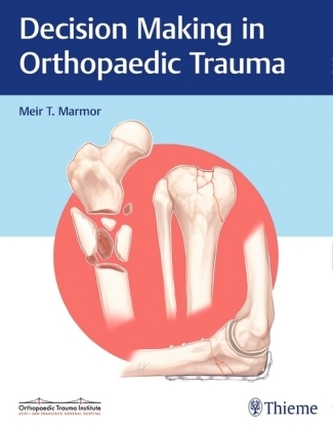
Decision Making in Orthopaedic Trauma
18
%
2094 Kč 2 544 Kč
Odesíláme do 3 až 5 dní
Sleva až 70% u třetiny knih
Few if any medical fields share the complexity of injuries and the number of available treatments that exist in orthopaedic trauma. Deciding on the most efficacious treatment can often be difficult. In this digital age with a tsunami of medical information and conflicting data on numerous approaches, practitioners who treat orthopaedic trauma often find it problematic to make evidence-based choices.
Decision Making in Orthopaedic Trauma is the largest compendium of orthopaedic trauma algorithms assembled to date. The decision trees cover a broad spectrum of cases - from simple isolated fractures - to severe, life-threatening conditions. The decisions on which action to perform in each situation are largely based on the personal experiences of the individual authors, all members of the University of California, San Francisco (UCSF) / Zuckerberg San Francisco General (ZSFG) Orthopaedic Trauma Institute. When the decisions are supported by published scientific literature, the relevant publications are cited.
Visually appealing, easy-to-comprehend decision trees detail underlying pathologies, suspected diagnoses, required imaging studies, possible treatment approaches, rehabilitation, expected outcomes, and postsurgical care. The format is more conducive to swiftly acquiring knowledge and making informed decisions than traditional texts and websites.
Key Features
Management of a wide range of emergencies including compartment syndrome, open fractures, peripheral nerve injuries, mangled extremities, and multiple trauma
Perioperative care - from acute and chronic pain management - to venous thromboembolism prevention and the use of regional anesthesia
Major sections organized by anatomic region cover upper extremity, lower extremity, pelvic, hip, and spine trauma
Clinical pearls on the management of osteoporotic, neoplastic, and periprosthetic fractures and fracture complications
Impacted anatomy, differential diagnoses, and possible approaches visualized through high-quality color illustrations and radiographs
Consistent color scheme differentiates actions, imaging, and rehabilitation guidelines
Appendices provide a quick reference on imaging, bracing, and rehabilitation recommendations
This uniquely formatted, visually rich book will enable surgeons, physicians, and residents to understand and apply critical decisions to a wide range of fractures, dislocations, nerve injuries, and musculoskeletal complications.
| Autor: | Marmor, Meir |
| Nakladatel: | Thieme, Stuttgart |
| Rok vydání: | 2017 |
| Jazyk : | Angličtina |
| Vazba: | Paperback / softback |
| Počet stran: | 190 |
Mohlo by se vám také líbit..
-
Otolaryngology - Head and Neck Surgery
Carlson, Matthew L.
-
Color Atlas of Pathophysiology
Silbernagl, Stefan
-
Kurzgefasste Handchirurgie
Rudigier, Jürgen
-
Fundamentals of Neurology
Mattle, Heinrich
-
Essential Radiology
Gunderman, Richard B.
-
Abdominal Ultrasound: Step by Step
Block, Berthold
-
Head and Neck
Möller, Torsten B.
-
Gastroenterologie compact
Koop, Irmtraut
-
MRT der Wirbelsäule und des Spinalkanals
Forsting, Michael
-
Examination of Peripheral Nerve Injuries
Russell, Stephen M.
-
Praktische EKG-Deutung
So, Cook-Sup
-
Caries Management - Science and Clini...
Meyer-Lückel, Hendrik
-
Functional Reconstructive Nasal Surgery
Huizing, Egbert H.
-
Anatomy for Plastic Surgery of the Fa...
Watanabe, Koichi
-
Diagnostik und Therapie des Mammakarz...
Fischer, Uwe
-
Strahlenschutzkurs für Mediziner
Schröder, Uwe G.