



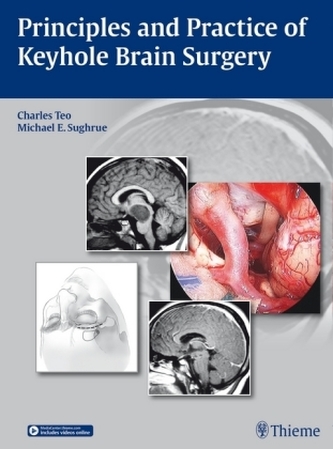
Principles and Practice of Keyhole Brain Surgery
17
%
3996 Kč 4 795 Kč
Sleva až 70% u třetiny knih
Technological advances in recent decades have allowed the miniaturization of cranial openings for performing brain surgery. Beginning in the 1990s, there was increasing experimentation with use of the endoscope in brain surgery, driven by such innovators as Thieme author Axel Perneczky, one of the first to champion the new 'keyhole' philosophy. During its early phase, neuroendoscopy was largely limited to intra-ventricular applications and there were serious concerns about the ability to address complications when they arose. Stemming hemorrhage with limited instrumentation through a burr hole with endoscopic visualization alone was difficult if not impossible.§Parallel developments in other areas were necessary to make keyhole surgery and neuroendoscopy truly feasible: introduction of anesthetic agents that reduce intracranial pressure; single shafted instruments that reduce cluttering; better hemostatic agents; better pre-operative imaging/planning, improved visualization with better microscopes and endoscopes and advanced intra-operative navigation using neurophysiology; awake techniques; biological tissue labelling and real-time imaging.§It is in this context that Teo's work shows its timeliness. It is being published at a time when keyhole surgery has reached a high level of maturity; when the enthusiasm about endoscopy in neurosurgery has been tempered by 20 years of experience with mixed results, so that the present book represents a meaningful and realistic hybrid between keyhole operative techniques with, and without, the use of the endoscope. It is about removing brain tumors through as small an opening as is possible, and placing these openings where the ensuing surgery will be most effective and efficient, and as free of complications as possible.§The book does not intend to be scientific, per se; rather, it presents the extensive experience of two brilliant neurosurgeons who have optimized minimally invasive techniques for brain surgery. Augmented by more than 100 procedural videos, the work is intended to function like an experienced mentor at one's side.
| Autor: | Teo, Charles |
| Nakladatel: | Thieme, Stuttgart |
| Rok vydání: | 2015 |
| Jazyk : | Angličtina |
| Vazba: | Hardback |
| Počet stran: | 272 |
Mohlo by se vám také líbit..
-
Gynäkologische Urologie
Petri, Eckhard
-
Atlas of Breast Surgery
Wallwiener, Diethelm
-

Differenzialdiagnosen in der Kinder- ...
Ploier, Robert
-
Orthodontic Postgraduate Education: A...
Eliades, Theodore
-
Training in der Neuroreha
Lamprecht, Sabine
-
Osteoporose
Bartl, Reiner
-
Dr. Vodder\'s Manual Lymph Drainage
Wittlinger, Hildegard
-
Head and Neck Cancer
Genden, Eric M.
-
NAP
Horst, Renata
-
Checkliste Traumatologie
Bühren, Volker
-
Infektionen in Gynäkologie und Geburt...
Petersen, Eiko E.
-

Sexuelle Störungen
Borcsa, Maria
-

Zwangsstörungen
Borcsa, Maria
-

Persönlichkeitsstörungen
Borcsa, Maria
-
Paartherapie
Borcsa, Maria
-
Psychosen
Borcsa, Maria